

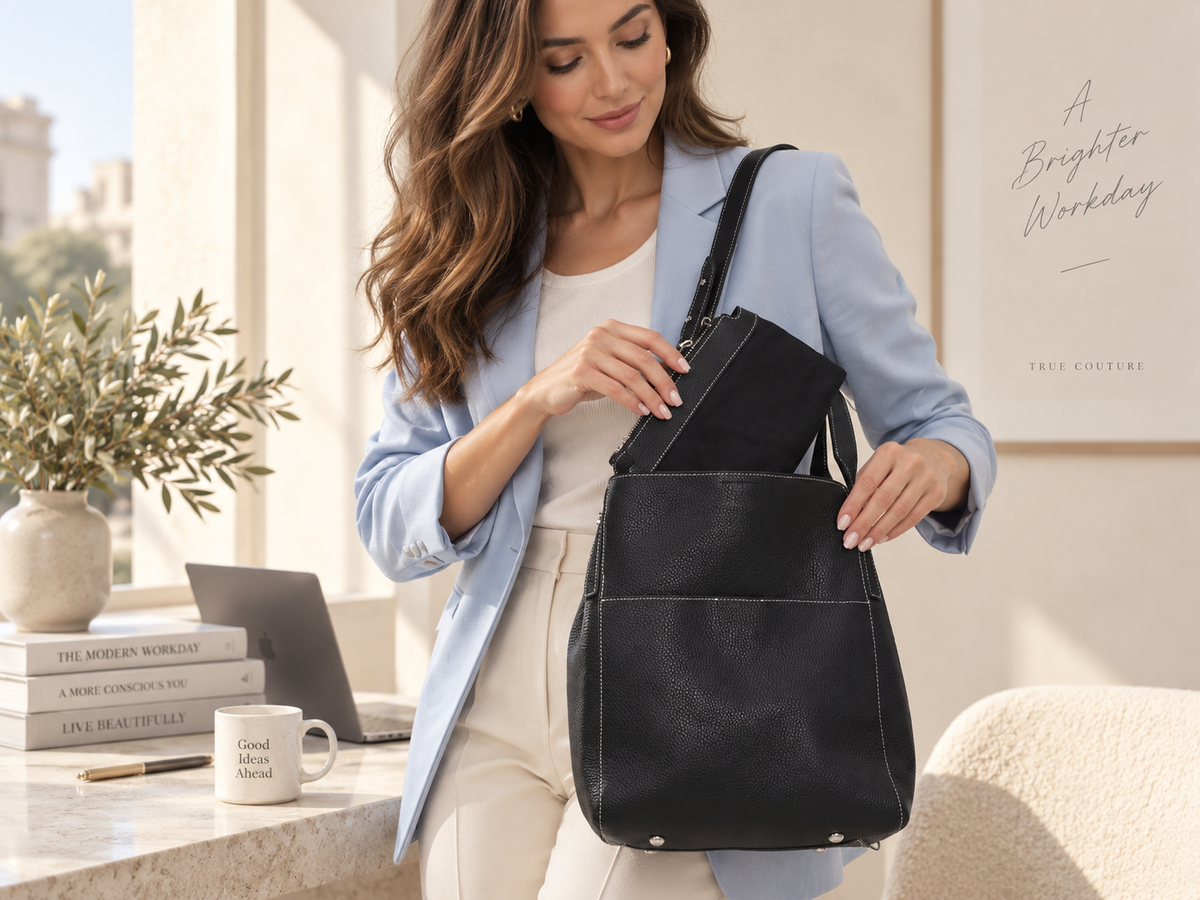
The Anatomy of a Better Tote
Why organization, security, straps, structure and materials matter more than simply choosing the biggest bag.

There is something strangely common in handbag design: the bigger the tote gets, the more likely the inside is to become one enormous open space.
It looks beautiful when it is empty.
Then real life happens.
Your keys disappear underneath your wallet. Your sunglasses end up beside a water bottle. Your charger gets tangled around everything else. You find yourself standing at a checkout counter digging through a bag large enough to carry half your day but somehow incapable of helping you find your lip balm.
And when the entire top is open, commuting with it can feel even less practical.
That raises a surprisingly important question: why are so many tote bags designed without meaningful compartments or secure storage?
Part of the answer is aesthetics. Minimal interiors preserve a clean silhouette, are less restrictive and allow one large space to accommodate objects of different sizes.
But minimal should not have to mean inconvenient.
A Large Tote Doesn't Automatically Mean a Useful Tote
Capacity and usability are not the same thing.
A huge uninterrupted interior technically gives you more room, but once you start adding a wallet, makeup pouch, charger, notebook, tablet, sunglasses, hand cream and the other pieces that accumulate during a normal day, that space can quickly become a black hole.
The opposite can be annoying too.
A tote with fifteen tiny pockets may look impressively organized in a product photograph but force you to remember which miniature compartment holds what.
The sweet spot is usually somewhere in the middle: open space for flexible everyday carry combined with secure storage for the things you don't want floating around.
More space is useful only when the interior still helps you find what you put inside it.
 Organization without over-complication
Does a Work Tote Really Need a Zipper?
Not necessarily.
There are several approaches to tote security, and each solves a different problem.
Full zip top
Maximum closure for commuting, travel and anyone who prefers everything enclosed.
Open top
Faster access and greater flexibility when you're constantly reaching in and out throughout the day.
Hybrid interior
Open sections for quick access paired with a secure zipped center for valuables.
The question therefore shouldn't simply be: “Does this tote have a zipper?”
A better question is: “Which parts of this bag need to be secure, and which parts do I want to access quickly?”
That tells you much more about whether the layout will actually work for the way you use a handbag.

The Best Compartments Are the Ones You Actually Use
There is no universally perfect interior.
Some women want a completely open tote because they organize everything with their own pouches.
Others want everything divided.
Plenty of us want something in between.
A practical work tote should make the most important items easier to find without turning the interior into a filing cabinet.
Open section + secure central section + open section.
The open areas can handle the things you move in and out of throughout the day. The center gives smaller or more valuable items a defined place.
A removable pouch adds another layer of organization without permanently forcing the bag into one configuration.
That is very different from simply adding pockets because “more pockets” sounds better on a product page.
Good handbag design should remove friction.
You should not need an instruction manual to remember where you put your keys.

Pay Attention to the Straps Before the Interior
This is one of the easiest details to overlook when buying a tote online.
A beautiful bag becomes frustrating very quickly if the shoulder strap slides off, feels too short over a jacket or places all the weight on a narrow section of your shoulder.
For a bag intended for everyday use, think about how you actually carry it.

Structured vs. Slouchy Is More Than an Aesthetic Decision
Structure changes how a tote behaves. A rigid bag stays upright and keeps smaller items easier to locate; a softer tote moves more naturally against the body.
The useful middle ground is a semi-structured tote: enough shape to feel organized, with enough movement to stay comfortable in everyday use.

Check the Empty Weight Before You Fill the Bag
A tote can look beautiful and substantial, but if it already feels heavy before your wallet, charger and daily essentials go inside, that weight adds up quickly.
When comparing a leather work tote, pay attention to the material, hardware, lining and base construction — not just the outside dimensions.

Don't Assume “Work Tote” Means “Laptop Bag”
A work tote and a laptop tote are not automatically the same thing. Many women carry a tablet, documents, wallet, phone, charger and personal essentials without putting a computer in the same handbag.
If laptop capacity matters, check the actual device dimensions, usable interior width and opening of the bag rather than relying only on the screen size.
A 13-inch screen measurement does not tell you the physical width of the computer. The Waymark is not designed to fit a standard 13-inch laptop.
Material Changes the Entire Experience
Leather, suede, canvas and nylon can all make excellent totes.
They simply behave differently.
A pebbled leather tote tends to work particularly well for frequent everyday use because the natural texture makes small surface changes less visually obvious than on very smooth leather.
Suede creates a softer, more tactile appearance and changes the same silhouette completely.
That is one reason color alone does not define a handbag.
Material can make the exact same shape feel more relaxed, more directional or more traditional.
A good tote should therefore be chosen not just by color, but by how and where you expect to carry it.
 Same idea. Different texture.

The Design Problem We Wanted the Waymark to Solve
We designed the Waymark around one simple idea: give an everyday work tote enough organization to make sense without filling it with unnecessary features.
Its semi-structured interior uses two open sections surrounding a central zip compartment, so frequently used items stay easy to reach while valuables have a more secure center.
The Waymark is not designed to fit a standard 13-inch laptop. If carrying a laptop inside your tote is essential, measure your device and choose accordingly.
For a tablet, documents, wallet, charger, pouch, phone and the other pieces that collect through the day, the idea is simple: enough structure to make sense without dividing the bag into twenty little places.
So, What Should You Look for in a Work Tote Bag?
Before buying your next everyday tote, forget the logo for a minute and look at how the bag is constructed.
The best work tote is not necessarily the tote with the most compartments, the most expensive leather or the largest measurements.
It is the bag whose design quietly makes sense once you start using it.


