

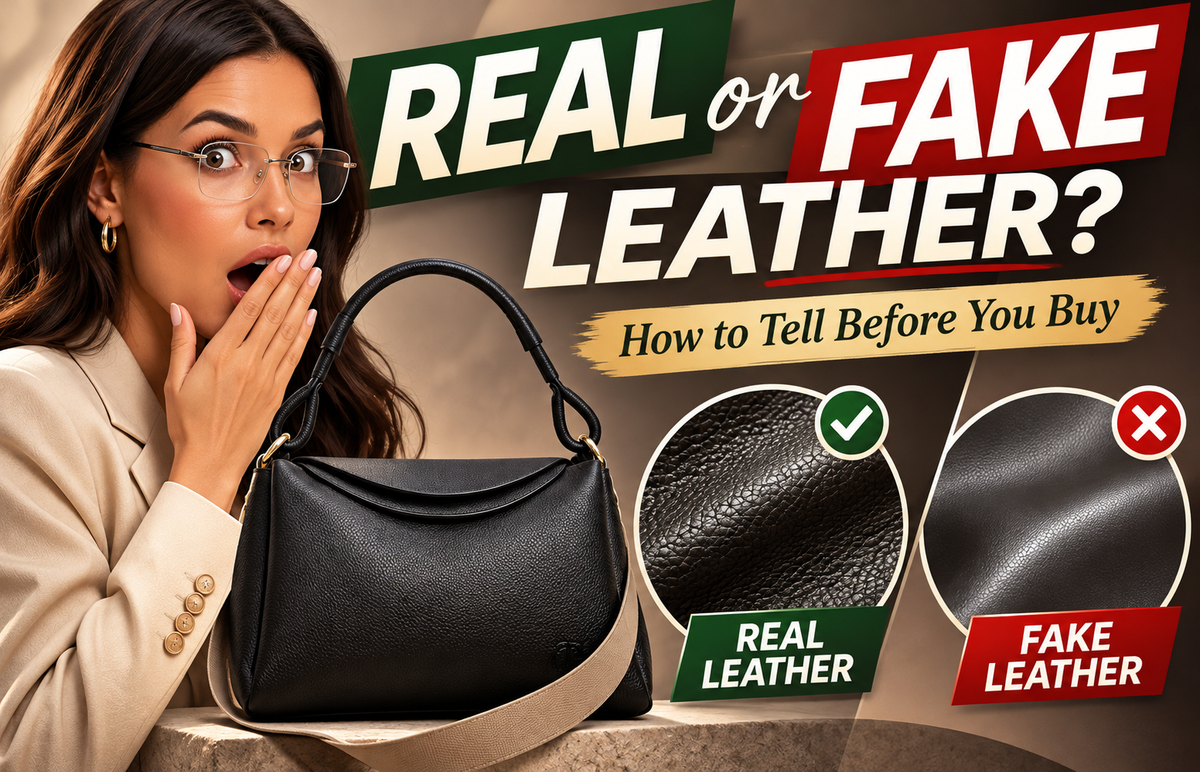
How to Tell If a Bag Is Real Leather
Seven smart checks before buying online—plus the close-up details that photos can (and cannot) reveal.
 ELAINA / GENUINE PEBBLED LEATHER
Good photos help. Clear material details matter more.
Real and faux leather can look surprisingly similar online. Genuine leather can be embossed, corrected, polished or heavily finished; synthetic materials can be made with realistic pores, creases and grain patterns. That is why a beautiful close-up is a clue, not a certificate of authenticity.
Before buying, look for a precise material description, inspect several product details and ask questions when the listing is unclear. Use the visual checks below to know which photos to request—and what they can reasonably tell you.
Real leather vs. faux leather: what should you look for?
Use matched photographs with the same lighting, magnification and angle. The differences can be subtle, and neither texture alone proves composition.


Variation in grain, natural markings, pores or fine creasing can appear depending on the hide and finish. A corrected or embossed genuine leather may still look uniform.
Some synthetic surfaces show highly regular embossing or a film-like finish. Good PU leather can imitate natural markings convincingly, so the pattern is not definitive.
Know the names. Know the differences.
A handbag's material description tells you more than a stamp or a beautiful photograph. Learn the terms below, then compare how different leather and synthetic surfaces can look. Exterior, lining and trim may all use different materials.
| Listing wording | What it tells you |
|---|---|
| Full-grain leather | Leather retaining its original grain surface. |
| Top-grain leather | Leather from the grain layer; may be finished or corrected. |
| Split leather / suede | Can be genuine animal-hide material, with different surface characteristics. |
| Genuine leather | Signals real leather, but does not by itself tell you the construction quality. |
| Bonded leather | A composite made using leather fibers and binders; not equivalent to intact-hide leather. |
| PU / PVC / faux / leatherette | Describes synthetic or imitation leather materials. |
| Leather-look / vegan leather | Not a claim of animal-hide leather; ask what the actual material is. |
Terminology reference: Leather Working Group definitions. For U.S. marketing disclosures, see the FTC Leather Guides.


Grain tells a story. It doesn't tell the whole story.
Compare surfaces at normal viewing distance and in macro. Real leather can be very smooth; faux leather can show convincing irregularities.


Look for: changes in grain scale, natural markings and the way the surface responds to bends. These may give you questions to ask a seller, but they are not an at-home laboratory test.
Don't assume: perfectly even grain means fake, or visible creases mean real. Finishing, embossing and photography affect both materials.
Look at the edges, backing and layers.


On some unfinished samples, real leather shows a fibrous interior. Synthetic alternatives may reveal a fabric backing or a distinct coating layer. These clues are easier to see in sample swatches than on a fully finished handbag.
Many authentic luxury leather bags have painted, folded or sealed edges. A smooth, tidy edge is not evidence of imitation leather. Ask for a macro photo of the material edge only when one is visible.
Three more checks before you buy.

Ask for natural-light photos
Strong studio light can hide grain or make synthetic coatings appear richer. Ask for a front, side and interior photo in ordinary daylight, plus one sharp close-up.
The point is to verify that every photo depicts the same bag—not to guess the material from brightness.

Inspect construction—but keep it separate from authenticity
Even stitches, reinforced handle attachments and secure hardware help you judge workmanship. They do not prove a handbag is made of leather: a well-made faux-leather bag can have excellent construction, too.
Want to check stitching, construction and hardware more closely? Visit the True Couture journal for our guide to evaluating leather handbag quality.

Think about how the material will wear
A new handbag can look flawless, but the edges, corners and frequently flexed areas tell you more about long-term wear. With care, genuine leather may soften and develop character over time; it can also scratch, fade or dry out.
Many faux leathers use a synthetic surface coating over a textile backing. Depending on the formulation and use, that coating can crack, peel or separate, particularly around folds. Some premium synthetics last well too, so don't judge durability from material name alone.
Before buying: Look for close-ups of the corners, strap attachments and high-friction areas—especially when shopping secondhand. A clear material description matters more than a perfect-looking photograph.
Your 60-second leather bag checklist.
- Is the exterior material stated explicitly?
- Does the listing distinguish leather from PU, PVC, coated trim or fabric lining?
- Can I see a clear grain close-up and a full front view?
- Are edges, handles and interior photographed?
- Have I looked at corners, seams and stress points for possible wear?
- Do I understand the return policy before ordering?
Photos alone cannot confirm composition. Compare the material description with multiple views and contact the retailer if anything is unclear.
Know what you're carrying.
Detailed product descriptions are part of informed shopping. The Elaina Everyday Black Leather Shoulder Bag is described on its product page as having a genuine pebbled-leather exterior, a neutral lining and gold-tone hardware.
Look for clear material descriptions and useful close-up photography—then choose a bag you love for both its design and everyday practicality.

Still wondering? Start here.
Can you tell if a handbag is real leather just from pictures?
Not with certainty. Grain, edges and backing can offer clues, but finishing and embossing can make real and synthetic materials look similar. Confirm the material description and ask the seller directly.
Does an even grain pattern mean the bag is fake?
No. Genuine leather can be corrected or embossed to create a consistent surface, and synthetic leather can be embossed with a realistic grain. Compare the whole product and its documented material.
Is bonded leather the same as genuine hide leather?
No. Bonded leather is a composite containing leather fibers with binders. It should not be represented as the same material as intact-hide full-grain or top-grain leather.
Do painted edges mean the bag is synthetic?
No. Edge paint and sealed edges are common finishing techniques on genuine-leather goods. The presence of edge paint does not determine the material underneath.
What should I do if a bag arrives with materials different from the listing?
Save the original listing, take clear photos, contact the retailer and request a remedy under the applicable return or marketplace policy. If necessary, use the platform's dispute process and keep records of the correspondence.
Great style begins with knowing the details.
Understand the material, study the details and choose thoughtfully. Confident shopping starts with good information.
Explore True Couture ↗

