

How to Tell If a Leather Bag Is High Quality
Leather type matters — but it is only one part of the story. Here is how to judge the material, stitching, edges, hardware and construction that actually determine whether a handbag feels refined and holds up to everyday use.

Quality is a system, not a single leather label.
- Full grain and top grain can both be excellent handbag leathers. They create different finishes and different visual character.
- Construction matters just as much: inspect stitching, reinforced stress points, edge finishing, hardware and interior assembly.
- Pebbled describes texture, not grade. A top-grain pebbled leather can be a strong choice for a polished everyday bag.
- Judge the finished bag. A beautifully made top-grain bag can be a better purchase than a poorly constructed bag marketed only by a premium-sounding leather term.
What actually makes a leather bag high quality?
The leather is the starting point. The finished handbag is the test.
Two bags can use the same general leather category and still feel completely different in your hands. One may have carefully selected panels, even stitching, clean edges and securely attached hardware. The other may use thin pieces, weak stress points or rushed finishing.
That is why judging a bag by one phrase — even a phrase such as full grain — tells you less than looking at the product as a whole.
Leather
Look at the grain layer, surface finish, hand feel, thickness and whether the leather suits the intended silhouette.
Construction
Stitch consistency, panel alignment, reinforced stress points and base structure determine how the bag behaves in real use.
Finishing
Edges, lining, zipper installation and clean interior seams are often where better manufacturing becomes obvious.
Hardware
Rivets, feet, rings, buckles and zippers should feel securely integrated rather than added as decoration.

Full grain vs top grain: it is not a simple winner-and-loser chart
Full-grain leather keeps the grain surface intact without corrective mechanical treatment. In consumer handbag language, top-grain leather usually refers to leather from the grain layer whose surface has been refined or finished to achieve a more controlled appearance.
Those are different approaches to the surface of the hide. They do not automatically tell you how well the finished handbag was made.
| Leather | What it means | What shoppers may notice | Why a maker may choose it |
|---|---|---|---|
| Full grain | The natural grain surface remains intact. | More visible natural variation; marks and character can become part of the way the bag ages. | Chosen when preserving the natural surface and character of the hide is central to the design. |
| Top grain | Leather from the grain layer with a surface that may be refined and finished. | A more controlled, consistent surface with the feel and structure of real leather. | Well suited to polished handbags where consistency, color and a refined finish are important. |
| Corrected grain | The grain is partially removed by buffing and enhanced with finishing. | More uniform appearance and less visible natural variation. | Chosen when the design requires a particularly consistent surface. |
| Split / bonded | Lower layers of the hide, or leather fibers bonded with other materials. | Quality varies widely and the material generally behaves differently from grain leather. | Often used where cost, weight or a specific construction calls for it. |
For a handbag, the right leather depends on the design goal. Natural character, polished uniformity, softness, structure and surface protection can all lead a maker toward a different finish.
Industry terminology is more nuanced than the simplified “five grades” charts common online. For technical definitions, see the Leather Working Group glossary and Leather Naturally’s leather FAQ.
Why pebbled leather works so well for everyday bags
Pebbled is a surface texture, not a leather grade. That distinction matters.
A pebbled finish gives a large leather surface more visual depth and creates the tactile look many people associate with an everyday luxury handbag. It can also make small day-to-day surface changes less visually obvious than on a perfectly smooth finish.
For a tote, that combination makes sense: the bag can still look refined while being carried often.
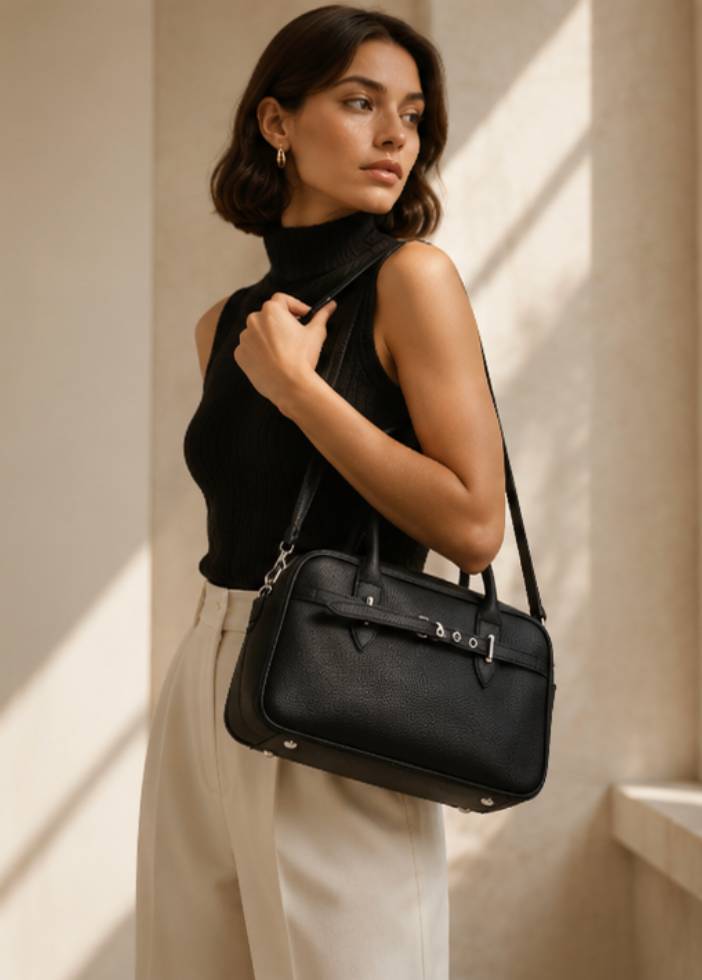
At True Couture, the Waymark uses top-grain pebbled leather selected to balance a polished surface with the structure needed for an everyday work tote.
See Waymark in Black See Waymark in Brown
Construction details that tell you more than a buzzword
If you want to know whether a bag was made carefully, inspect the areas that take the most stress.
These points repeatedly carry the weight of the bag. Look for secure stitching, reinforcement and hardware that sits firmly against the leather.
Spacing should remain even along long seams and through corners, with no skipped stitches or loose threads at high-stress areas.
Handles and straps see constant contact. Their edges should look smooth, clean and intentionally finished rather than raw or fuzzy.
Zippers, rivets, feet and buckles should feel secure and operate smoothly without pulling or wobbling against the leather.
A work tote should maintain enough shape to carry its contents without the bottom collapsing under normal everyday use.
Look inside. Pocket seams, lining, zipper installation and internal dividers are often where manufacturing quality becomes easiest to judge.

Inspect the parts that carry weight.
Decorative details are easy to photograph. Stress points are more revealing.
Zoom in on handles, shoulder-strap anchors, corners, the base and zipper ends. A bag that is intended for everyday carry should look deliberate in those areas — not merely beautiful from the front.
That is also why online listings with detailed interior and side photographs are more useful than pages that show only one perfect hero angle.
Quality starts with leather. It does not end there.
For our leather styles, True Couture uses top-grain leather selected for the finish and structure each silhouette requires.
With the Waymark, the goal is a polished everyday tote with enough shape to stay organized, enough flexibility to remain comfortable and details that make the bag useful beyond the first impression.

Why a maker may intentionally choose top-grain leather
A cleaner visual surface
Refining and finishing the grain can create more consistent color and texture across the multiple panels needed to build a handbag.
The finish can serve the silhouette
A structured tote, a soft hobo and a compact crossbody do not need to behave in exactly the same way. Material selection should follow the design.
Refined does not mean inferior
A controlled surface can be exactly what gives an everyday handbag its polished, repeatable look from one piece to the next.
How to judge a leather bag when you cannot touch it
Online shopping removes the easiest test — handling the bag yourself. That means the product page needs to give you enough visual and technical information to compensate.
- Close-up photographs of the leather texture.
- Front, side and bottom views — not only lifestyle images.
- Clear photographs of handles and strap attachment points.
- Interior images showing seams, pockets and zipper installation.
- Material information that goes beyond a vague “premium leather” claim.
- Dimensions, empty weight and carrying options.
- Care guidance appropriate to the material.

Leather bag quality FAQ
Is full-grain leather always better than top-grain leather?
No single leather term can tell you the quality of a finished handbag. Full grain preserves the natural grain surface, while top-grain leather may be refined or finished for a more controlled appearance. Both can be used in high-quality bags. Construction, finishing and the suitability of the leather for the design still matter.
Is top-grain leather good for handbags?
Yes. Top-grain leather is well suited to handbags because it uses the grain layer of the hide while allowing the surface to be refined for consistent color, texture and finish. It is particularly useful when a designer wants a polished, repeatable appearance across multiple panels.
Is pebbled leather lower quality?
No. “Pebbled” describes the surface texture, not the grade of leather. Pebbling can be used on quality grain leather and is popular for everyday handbags because the texture adds visual depth and can make small surface changes less noticeable.
How can you tell whether a leather bag will last?
Look beyond the leather name. Inspect the stitching around handles and corners, edge finishing, hardware attachment, base construction and interior assembly. Durability comes from how the entire bag is engineered and finished.
How can you tell if a leather bag is real?
Start with the product description and labeling, then inspect detailed photographs for natural depth, flex and texture. Real leather can be finished in many ways, so perfectly visible pores are not a universal test. A trustworthy seller should clearly identify the material rather than relying only on vague terms.
What should I look for in a leather work tote?
Look at empty weight, strap options, base structure, secure storage, interior organization and whether the handles are reinforced where they meet the bag. For a deeper breakdown, read our work tote buying guide.
Look at the leather. Then look at everything around it.
Full grain is valued for its natural surface and character. Top grain is valued for the refined, controlled finish it can bring to a handbag.
What separates a quality bag from an average one is how thoughtfully the leather has been selected — and how carefully the entire product has been constructed.
Look at the stitching. Look at the handles. Look at the edges, hardware, interior and structure. That tells you far more about a handbag than one marketing term ever will.


